Showing posts with label chiropractor. Show all posts

Thursday, 2 July 2015

30 Years of Adventure

30 years ago today I began practice in Medicine Hat, Alberta.  After graduating from Life Chiropractic College - West in December of 1984, my wife Pamela and I moved back to our home town of Medicine Hat to begin our careers as chiropractors.  With one young son and another on the way, I would practice solo until Pamela was comfortable leaving the boys. Graduating is one step to beginning practice.  National and provincial examinations needed to be successfully completed before a license would be issued to practice in Alberta.  On July 2, 1985 everything was in place for me to take over the Arcade Chiropractic Office from Dr. Ian Smith.  A great adventure began that day!

Looking back over the past 30 years, it has been an adventure indeed.  I have experienced and learned so much.  There have been many, many challenges and countless blessings. 
When I started practice, I thought I knew a great deal about chiropractic and health.  I was an honours grad after all.  Now, I know that I knew very little and that I still know just a tiny amount about the amazing human body.  That's one reason I am so thankful to be a chiropractor.  I don't need to know the minute workings of the body in order to help it.  I just need to know how to release it's potential.  That's what chiropractic does.  My job is to become ever more proficient at delivering chiropractic adjustments to enable my patients to experience the health they innately possess.  Along with the adjustments I have provided healthy lifestyle counseling to help people avoid the use of drugs and surgery whenever possible.

Upon reflection, there are many things from these years of practice that warm my heart.  There are the people who came to me, after having been everywhere and tried everything without success, and experienced a restoration of their health.  There are the young parents who were able to experience the joy of having a baby that didn't cry constantly.  There are the young children whom I adjusted who are now bringing their children to see me.  There are the smiles of the people who can sleep again, or walk again, or play again.  There the patients who have been able to return to work and support themselves and their families.  There are the support staff who have been able to be part of something greater than just having a job.  There are the associate doctors who have had the opportunity to develop skills to become great servant chiropractors.

I've also learned some other very important lessons.  Not everyone likes me or chiropractic.  I get fired on a regular basis.  I'm good with that.  Not all patients get the results either they or I desire, but I know their bodies are better for having been adjusted.  Not everyone values their health the way I value mine and they may not be prepared to work at, or invest in, being healthy the way I do.  Once I think I have things figured out, God sends someone through the door to prove me wrong.  Being the boss may seems like an enviable position, until the tough decisions need to be made and the tough actions need to be taken.  This has been 30 years of constant learning and it will continue to be as long as I am in practice.

Chiropractic has been good to me.  It has caused me to grow in innumerable ways.  It has given me a purpose bigger than myself.  There is no greater joy than helping people on a daily basis.  Chiropractic principles have guided me to live a healthy life.  I have been able to help my family be healthier as well.  Chiropractic has also given me and my family a very good and satisfying lifestyle.  I'm thankful every day that I'm a chiropractor and I have no desire to be in a different profession.  Let the adventure continue!  


Wednesday, 4 March 2015

Mastering the Tough Stuff

Usain Bolt receives a masterful chiropractic adjustment
When I graduated from Life Chiropractic College - West 30 years ago, I thought I had a pretty good handle on what it took to be a chiropractor.  Graduating near the top of my class I certainly had a lot of knowledge.  I also thought I had the skill to give a pretty good chiropractic adjustment.  When I started practice a few months later, I quickly realized that my knowledge and skill levels were far less than what I needed to be a great chiropractor.  There are still many days when I'm not sure I have arrived.  I still have much to learn about being a chiropractor.

In my early practice years I would go to seminars and watch to see how successful chiropractors conducted themselves.  The truly masterful adjusters had been in practice for years and regularly saw many, many patients.  People were attracted to their practices because their adjustments were extraordinarily effective.  Patients got results from these chiropractors they didn't get elsewhere.  Most of these chiropractors had one focus - to deliver outstanding chiropractic adjustments.  How did they get to be great adjustors?  They adjusted a lot of people and constantly focused on how they were providing those adjustments.  They weren't satisfied with being mediocre.  It was a constant that I observed in those who delivered outstanding adjustments regardless of which chiropractic technique they used. 

In Malcolm Gladwell's book, "Outliers", he proposes that in order to become truly great in a given field, a person needs to practice for 10,000 hours.  This applies to athletes, musicians, computer programers, scientists and, by extrapolation, even chiropractors.  While there may be holes in his theory, my experience is that when I had been in practice for 10,000 hours my skills where exponentially better than when I started practice.  When I had delivered 10,000 adjustments, my adjustments were amazingly more effective than when I thought I was a good chiropractor after graduating.  As I look back there has been a constant improvement of the effectiveness of my adjustments over the years.  I believe I am giving better adjustments today than I gave 5 years ago.  I see the same thing in my associate doctors.  They are becoming better and better with constant practice.  The more adjustments they give, the better the adjustments they give. 

I'm moved to reflect on the importance of mastering the difficult skill of the chiropractic adjustment because of a growing trend in the chiropractic profession.  There are groups of chiropractors, even here in Alberta, who are pushing to have chiropractors prescribe drugs.  Now there is a time and place for drugs to be used, but that should remain in the hands of those who's focus is medication - the medical profession.  There are real dangers for chiropractors being able to prescribe pain killers and muscle relaxants.  One such danger is that it is too easy.  Young chiropractors who have not yet mastered the chiropractic adjustment will be drawn to prescribe drugs to make up for the deficiency in their adjusting skills.  As a result they will prescribe more and adjust less never becoming masters and their patients will be worse off for it.  The default for most people, including professionals, is to take the easy road.  Sadly, when chiropractors are not masterful adjustors, patients usually don't get the results they were seeking and think chiropractic doesn't work.  Even more significantly the powerful effects of chiropractic on overall health are missed.  The great potential for these people has been denied because of the failure of the chiropractor to give the patient a great adjustment.

It has been fortunate for the chiropractic profession that we have not been able to prescribe drugs.  It has forced us to refine and master the chiropractic adjustment.  The result is that chiropractic has developed an enviable record of both results and safety.  This has not been an easy road for my profession, but it has been the right road.  The beneficiaries of taking this difficult path are the many patients who have had life changing experiences because of masterfully delivered chiropractic adjustments.  I pray that my patients are among those people.


Monday, 25 August 2014

Staying Healthy - According to Mark Twain

"The only way to keep your health is to eat what you don't want, drink what you don't like, and do what you'd rather not."  Mark Twain from "Following the Equator" (1897)

Mark Twain is recognized as having been a very insightful individual.  Even in his humour he was a remarkably astute observer of human nature.  This quote was likely very truthful back in 1897 when he wrote it and is relevant today as well. The implication is that what we like the most to eat, drink and do may not be the best for us.

Mr. Twain is reminding us that good health is the result of the choices we make.  Having a healthy lifestyle often means making choices which we would prefer not to make but need to make for the sake of our well-being.   There are three areas in which he says we need to make the right decisions and not necessarily the easy decisions.

The sad fact is that so many foods that we like and that taste good are really detrimental to our health.  They taste good because of added sugars, unhealthy fats and chemical flavour enhancers.  Yummy tasting food is often devoid of essential nutrients as well.  So these foods are not only harmful, but empty as well. These are the foods we want to eat.  To be healthy we need to make food choices based not only on taste, but on nutritional content.  Pick the vegetables instead of the ice cream.

The same is true for what we drink.  Drinking water or tea is a healthier choice than pop or beer.

Then Mr. Twain says we need to do what we'd rather not do. The list of lifestyle choices which lead either to poor health or better health are long.  Choose to get adequate rest and exercise.  Develop stress control methods. Establish supportive relationships. Enjoy the sunshine. Get regular chiropractic adjustments and adopt a healthy chiropractic lifestyle. 

Good health comes from deciding to do what is best rather than what is easy or what we want.  The results are worth the effort.

Monday, 23 June 2014

Does Everyone Need to See a Chiropractor?

When people first find out I'm a chiropractor, there are two common responses.  First, is that they have been to a chiropractor and want me to "crack" their back or neck for them, often implying I should do it right there in the restaurant or wherever we may be.  Second are people who say, "I don't need to see a chiropractor.  I don't have back pain."  Should people who don't have pain go see a chiropractor?

It wasn't all that long ago that people only saw medical doctors when they were sick.  They only consulted a dentist when they had a tooth ache.  I'm old enough to remember those days.  The idea of consulting a health professional for prevention of problems is a fairly recent phenomenon.  Most of our society now sees the logic in seeing an MD, dentist, or optometrist before problems arise for either prevention or early treatment.  Using the same logic, it also makes sense to see a chiropractor before back pain, neck pain or headaches become problems.

Since every person has a spine, everyone has the potential to develop spinal problems.  Statistically, 80% of Canadians will experience back pain over the course of their lifetime.  For many of those people it will be debilitating; interfering with their ability to work or perform activities of daily living.  But the effects of spinal problems are not limited to pain.  Abnormal function of spinal joints results in irritation to adjacent spinal nerves.  This produces alteration of nerve function through the entire path of that particular spinal nerve.  The result can be health problems distant from the spine itself.  A person can suffer detrimental effects of spinal problems without actually having pain in their spine.

Chiropractors use the term, Vertebral Subluxation, to describe abnormally functioning spinal joints with associated nerve irritation.  It may or may not be accompanied by pain.  Chiropractors are uniquely trained to detect and correct Vertebral Subluxations.  Like most conditions, Vertebral Subluxations can be most effectively treated when they are detected early.  Once abnormal spinal joint function becomes chronic, associated muscles adapt patterns where they are either too tight or too lax.  The ligaments of the joints are weakened.  Blood supply to the joints is altered as well.  It's also significant that chronically irritated spinal nerves heal very slowly.  Consequently detecting and correcting Vertebral Subluxations early, even before there is associated pain, makes a lot of sense.  Seeing a chiropractor when you don't have back pain, neck pain or headaches is as logical as seeing a medical doctor when you aren't sick or a dentist when you don't have a toothache or an optometrist when you can see well.  


If you are the type of person that only consults a health professional when they have an obvious problem, you likely won't grasp the logic of seeing a chiropractor when you don't have pain in your back, neck or head.  But that doesn't mean that you don't have spinal problems.  Waiting until you have pain can result in much more damage to the tissues and prolonged treatment.  As well when treatment is delayed the outcomes are often much less desirable.

As always whether you choose to see a chiropractor when you don't have pain is up to you.  But the logical approach is to get checked and assure your spine is working as well as it can so you don't end up with debilitating or chronic spinal problems.  Regular chiropractic adjustments should be part of your healthy lifestyle.


Tuesday, 27 August 2013

I Have Algorithms In My Head

When I'm consulting a patient for the first time I often tell them they are just like a jigsaw puzzle and I'm trying to put the pieces together so they make sense.  All the questions my staff ask and that I ask are designed to reveal glimpses of who this person is and what their condition really is.  Each examination procedure also reveals more pieces to the puzzle.  But just having all the pieces of the jigsaw on the table doesn't show you what the whole picture is.  The pieces have to be put together.  Each piece contains clues.  In a picture puzzle this includes shape, colour and pattern.  Every interconnection reveals more of what the whole will look like.

This is not dissimilar to the way I need to evaluate a patient.  Age, sex, family history, occupation, diet, physical activity, injuries, illnesses, and many other factors need to be probed.  Depending on the answer given to a particular question, it leads to the next question that needs to be asked.  The examination is then formulated from what has been gleaned from the history and consultation.  Each positive or negative finding leads to the test that should follow.

Over the years of evaluating many, many patients, I have developed algorithms that run through my mind to help me quickly and accurately assess what is going on.  An algorithm is defined as a formula or set of steps for solving a particular problem. To be an algorithm, a set of rules must be unambiguous and have a clear stopping point.  For example you can have an algorithm for baking a cake.  It might look like this:

Evaluating a patient is certainly more complex than baking a cake and instead of a simple algorithm, algorithms often need to be combined to get valid results.  If a patient has just one simple complaint, say a sprained ankle, there are few steps necessary to make the diagnosis and develop an approach for rehabilitation.  Few people present with such a simple situation.  Although a person may have one complaint, perhaps low back pain, there can be many factors which lead to the condition and usually involve more than just the lower area of the spinal column.  By having a logical sequence to follow, an algorithm, clues don't get missed and the best possible conclusions can be determined.  During both the history and examination of a patient with low back pain, algorithms for evaluating the lumbar spine, pelvis, and hips will likely be combined.  The knees, feet, and even the neck may be added depending on what is revealed.  

Activator Methods, my primary chiropractic technique, is based on a series of algorithms that allows for very efficient and thorough evaluation and adjustment of the spine and extremities.  The Activator Methods basic scan for the lumbar spine looks like this:
AMI Lumbar Spine Algorithm

This basic algorithm covers most low back conditions.  Should a patient present with a more complicated situation there are advanced algorithms that can be applied to evaluate the lumbar spine more thoroughly.    Following the algorithms leads to effective care of low back conditions.  There is less likelihood of missing pieces to the low back pain puzzle.

Whether I'm work with a new patient or during a routine office visit, I have algorithms constantly going through my mind.  As a result I can quick evaluate the spine and extremities for subluxations and determine the best chiropractic adjustments for a given patient.  By putting the pieces together I know where, when, and when not to adjust.  This is crucial to being an effective chiropractor. 
  

Sunday, 16 June 2013

Activator Methods Upgrading

Last weekend I participated in an Activator Methods Seminar.  The technique requires that in order to maintain my Advanced Proficiency status that at least once every year I attend a seminar to assure my competency in using the procedures.  This is something I really appreciate about Activator Methods.  They assure that all the doctors who are rated to use the technique, continue to maintain their competency.  This is important for patients and also for practitioners.

During the weekend our instructor, Dr. Rebecca Fischer, walked us through relevant research and showed us how to apply it in our practices.  Something that is not always easy to do is to take research and make it practical in a clinical setting.  In the rapidly changing health care world this is very valuable.  This year's focus was on osteoarthritis.  I appreciate not only the ongoing research that Activator Methods does but how they utilize research from many, varied sources to continually refine the technique.  There are few techniques that are so diligent.

Probably more important than the research however is the time spent on practical application over the course of the weekend.  Doctors are divided into basic, intermediate and advanced classes depending on their experience using Activator Methods.  In the advanced class with Dr. Fischer that I attended we spent a great deal of time refining our ability to use the technique.  That included hands on workshops, small group case studies, and a review of both old and new advanced procedures.  Nutrition, exercise, and lifestyle issues were integrated into the presentation and workshop.  This year the emphasis was on evaluating and treating the lower extremity.   Dr. Fischer and her helpers evaluated each attendee on their competency in using the Activator analysis.  It is wonderful to have this done every year.  It's amazing how many bad habits a person develops and this seminar always helps to bring back my focus.  There are also those, "Man I totally forgot about that test!" moments.

Not insignificant is the opportunity to connect with other like minded doctors.  This is often the only occasion where I get chance to see these people, may of whom are not from Alberta.  Time is spent sharing good and bad things that happen in our practices.  There is great value in this time of informal exchange.  I come away with a great confidence in many of the doctors I want to refer to and also recognize some I don't want to send patients to.

I commend Activator Methods for maintaining a system of quality control through their annual seminar requirement.  It's good for me as a doctor and also good for my patients.  For me it is not a burden, but a privilege to maintain my proficiency with Activator Methods.

Monday, 8 April 2013

What Makes Chiropractic Adjustments So Powerful?

A chiropractic adjustment is a very simple procedure.  The chiropractor analyzes a patient's spine for an area that has lost its proper position and motion.  Then a very quick, light thrust is applied in a specific direction to this area.  This may be done to one or several areas of the spine and the patient's spine has been adjusted.  Both the analysis and the procedure are quick and simple.

Most people visit chiropractors because of pain in the back or neck.  It's easy for them to make the connection between pain in the spine and the benefits of adjusting the spine.  But many of these people, who've come for relief of back and neck pain, find other positive things happen after receiving chiropractic adjustments.  Some examples from my practice over that past few weeks are:
  • the child who is no longer constipated
  • the man who no longer gets heartburn at every meal 
  • the lady who now sleeps comfortably through the night
  • the gentleman who no longer has constant hiccups
  • the baby who nurses without vomiting everything back up
  • the woman who can walk with her friends again without discomfort
  • the fellow whose jaw no longer "cracks" so loudly that it annoyed his family
  • the boy who no longer has chest pain and shortness of breath when he runs
There are many more examples I could list of positive, unexpected benefits patients in my office have experienced recently.  In each case, the person was analyzed for spinal problems and given simple chiropractic adjustments.

That a chiropractic adjustment can produce such a wide range of positive effects can seem amazing.  The power in the adjustment is not in the technique the chiropractor uses or even in the force that the chiropractor puts into the spine.  The power comes from what the body does with that force.  When areas of the spine have lost their proper position and motion it means that a Vertebral Subluxation is present.  Vertebral Subluxations also involve irritation of the adjacent spinal nerves.  Once the nerves are irritated, all areas of the body that depend on those particular nerves are negatively affected.  A chiropractic adjustment applied to a Vertebral Subluxation restores normal position and motion which then results normalization of the spinal nerves.  Once nerve function returns, truly amazing things can happen in the body.  The body can again function the way it was designed to.  The chiropractic adjustment can be likened to turning on a switch that gets the body working again.  Chiropractic adjustments turn the nerves on.  It's that simple.  That's why chiropractic adjustments are so powerful!

Wednesday, 20 February 2013

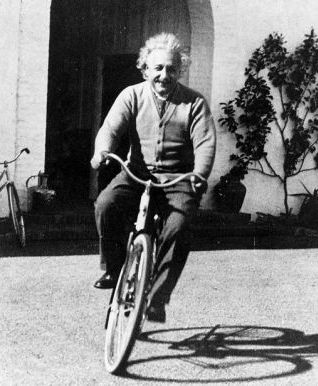
Life is Like Riding A Bike

"Life is like riding a bicycle.  To keep your balance you must keep moving."  Albert Einstein


Albert Einstein was a pretty smart fellow and not just in math and science.  When reading quotes from him, I have to conclude that he had a great grasp of what life is all about.  The quote above is certainly in line with a healthy chiropractic lifestyle.

Balance is a key to both physical and mental health.  I don't know whether Albert Einstein was referring to one or both of these areas of life when he made this statement.  Motion is crucial for health in both areas.

In physical health it's easy to see how motion is a critical element.  Motion tones our nerves and muscles and it keeps our circulatory system functioning.  As we move our body systems become coordinated so everything works together.  That is the prerequisite to having physical balance.

As a chiropractor, I am very focused on the how well my patients move.  The motion of the joints of the spine is particularly important.  Spinal joints that move either too much or too little will affect the nerves that exit the spine and go to all parts of the body.  This can lead to an imbalance in the nerves that control not only muscle activity but sensations such as pain and feelings as well as organ function.  When spinal joints loose their proper motion and the nervous system loses its balance, that is termed a vertebral subluxation.  Correcting vertebral subluxations with specific adjustments is what chiropractors specialize in.

Physical balance requires motion in more areas than just the spinal joints.  All the joints of the body must move properly and all the body's systems must be working together in a coordinated fashion.  Its the nervous system that assures the coordination of the entire body..

Being balanced mentally also requires motion.  Physical motion provides proper blood flow to the brain.  Through the blood the brain receives the oxygen, nutrients, and hormones necessary for it to work properly.  Also through physical motion the brain obtains stimulation from every part of the body.   Keeping mentally active is also necessary for to have mental balance.  Keep the mental "gears" turning through constant learning and stimulation to keep the mind healthy. 

A chiropractic lifestyle involves keeping the spine functioning properly as well as adopting healthy diet, exercise, nutrition, and sleep habit,   It's about managing physical, chemical, and emotional stresses so the body and mind can function the way they were designed to.  To be healthy we need to be balanced, physically and mentally.. Sitting in front of the TV in no way promotes balance.  Balance requires movement.  Take it from Albert Einstein, to be balanced we need to keep moving.  He was a wise man.

Tuesday, 1 January 2013

5 EASY STEPS TO BECOME UNHEALTHY IN 2013

If your New Year's Resolution is to become less healthy this year, I have 5 easy steps for you to take to reach your goal.

  1. Inactivity – Lack of physical activity will result in increased risks of circulation problems, heart disease, diabetes, digestive problems, sleep disturbances, muscle wasting, joint problems and mental health issues. It's not just physical activity you want to avoid but mental stimulation as well. Being a couch potato in front of the TV might be a great place to start.  This will minimize both your physical and mental activity levels.
  2. Poor Nutrition – Eat as much as you can of whatever looks good and tastes good. Go for high sugar, deep fried, highly salted, high calorie, processed and genetically modified foods.  Avoid natural foods, especially fresh vegetables (green = bad) and fruit.  Consuming large quantities of alcohol will also deplete your nutritional reserves.  Without essential building blocks the body is unable to repair itself and all its systems gradually breakdown.
  3. Poor Supplementation – Don't take any supplements.  Rely on the nutrient deficient foods you choose (see #2) to supply what your body needs, even though these foods don't have what the body needs.  Even more detrimental to your health is to take supplements that your body can't absorb or that are in forms that the body can't utilize. Choose low quality supplements that contain toxins and fillers. This is sure to stress the body chemically.
  4. Stress Response – Prolonged stress has been shown to be a causative factor in 8 of the 10 most costly illnesses. This includes cardiovascular disease, some cancers, gastrointestinal disorders, respiratory problems, spinal conditions, as well as mental health conditions.  So don't develop mechanisms to reduce your stress levels. Let your stresses eat away at you both mentally and physically.
  5. Nerve Interference – Don't worry about using proper body mechanics. Ignore aches, pains and stiffness in your spine.  A poorly working spine affects the nervous system, which is the master control of the entire body.   It only takes as much pressure on a spinal nerve as the weight of a dime to reduce the function of that nerve by 60%. Then every tissue that nerve goes to will be compromised. Be sure not have any chiropractic adjustments to correct vertebral subluxations and reduce nerve irritation in the spine.

I don't know which of these steps will cause the greatest deterioration in your health, but be assured that if you do all 5 of them you will definitely go downhill this year. It doesn't get any easier than that!  Going downhill is always the easy path.

But perhaps becoming unhealthy isn't really your resolution for 2013.  Do you instead want to get healthier? Then you will want to do the opposite of the things I've listed. Increase your physical and mental activity, improve your nutrition, take high quality supplements, control your stress levels, and reduce nerve interference with chiropractic care.  As chiropractors we can help you become healthier this year.

Monday, 11 June 2012

A PEBBLE IN YOUR SHOE

I've heard stories of monks who would deliberately put a pebble in their shoe so they would constantly be reminded of the suffering of Christ. A pebble in one's shoe is certainly an irritation. The pebble is felt on every step and the foot soon becomes irritated to the point that even when resting the foot is sore. It becomes impossible to step properly on that foot. Soon the knee, hip and low back become sore as the body compensates for the foot that isn't working properly. Even the mind is affected. Where does your mind go with every step you take? To the pebble of course. You just can't wait for the opportunity to take your shoe off and get rid of that pebble. The pebble doesn’t have to be very big either.  I can't imagine deliberately putting one in my shoe!

Even though a pebble in your shoe is a small thing, it can affect your entire body.  There is another even smaller thing that can affect your body.  That is a vertebral subluxation.  A vertebral subluxation is when there is a loss of proper motion between the joints of the spine which is accompanied by nerve dysfunction.  There is usually associated swelling and muscle spasms as well.  Pain may or may not be present, but there will be loss of function whereever the associated nerves travel.  A vertebral subluxation is such a small, subtle lesion that it takes a great deal of training and practice to accurately detect it.  Finding and correcting vertebral subluxations is what chiropractors specialize in.

Physical, emotional or chemical stresses can all cause vertebral subluxations.  Once a vertebral subluxation is present it is much like a pebble in a shoe.  It is a constant irritation to the body.   Even though no pain may be present when the subluxation first occurs, the longer it exists the more severe the associated problems will be.  Initially there may only be stiffness.  Later muscles will spasm.  Pain may occur early in the process or may never be part of the symptoms.  Common symptoms include back pain, neck pain, headaches, pain in the arms or legs, numbness, tingling, and weakness.  Even the internal organs can be affected when the nerves going to them are not functioning properly.

Chiropractors are specially trained in the detection and correction of vertebral subluxations.  The only solution for a pebble in a shoe is to remove the pebble.  The only solution for a vertebral subluxation is to restore normal spinal joint and nerve function with specific chiropractic adjustments.

Friday, 9 March 2012

Staying Off the Treadmill

No, this is not an anti-exercise post.  The treadmill I'm referring to today is about running to get ahead but ending up going nowhere.  Specifically it's the medical treadmill I'm going to talk about.  It's the treadmill people find themselves on when they run from doctor to doctor, take test after test, are subjected to procedure after procedure, and take drugs followed by more drugs looking while looking for help with their health problems.  It's a treadmill that wears people down.  I see young people stressed into anxiety and depression, middle aged people worried to the point of developing new illnesses, and seniors totally exhausted physically and emotionally from being on this treadmill.  I also see people of all ages who have made a conscious effort to either stay off the treadmill or get off it once they recognize they are on it.  These people are both happier and healthier than those who are continuing to run.

I must let you know that I am not against tests, procedures and medications.  I am against tests just for the sake of running tests.  I'm against invasive procedures conducted before conservative methods are exhausted. While prescription medications can be absolutely essential for treating many conditions, they invariably have side effects.  These side effects usually necessitate additional testing and in very many cases more medication to treat the side effects.  The cycle of testing and medicating can become relentless; like running on a treadmill that can't be stopped.  This is especially true for chronic conditions for which medicine has a poor track record of treating.

Staying off the medical treadmill can be a daunting task.  The first step is to acknowledge that you are the person responsible for your health.  You can seek the advice of others and partner with other people, including doctors, but you must make the decisions regarding your health.  This is a crucial step.  It means you must become informed about your health situation.  You need to explore your options and  weigh the risks and benefits of any tests or treatments.  There are times you will need to say, "No".  No one but you can decide what is best for you.

The second step is to adopt a lifestyle that promotes health.  The best way to stay off the medical treadmill is to not get sick in the first place.  I've talked about lifestyle in several previous posts, but let me quickly list a few of the basics.  You need to eat nutritious food, drink plenty of water, avoid toxins, get adequate rest, manage stress, maintain good relationships, attend to spiritual matters, exercise, and look after your nervous system.

Now maybe you've had the misfortune of already having your health compromised through injury or illness.  You can get off the treadmill.  You must first go back to step one and take responsibility for your own health.  You need to become the decision maker.  Do your homework and find out as much as you can about what is afflicting you.  Research the treatment options.  Look for treatment methods that work with your body and aren't going to cause side effects.  Look for professionals you can partner with to help you reach your health goals.  Make lifestyle changes that will strengthen your body so it can heal itself.  The body is marvelously self healing when it's given the proper environment to do so.

In more than a quarter century of practicing chiropractic, I've observed many, many people enjoying wonderful health in their advanced years.  Invariably they are the ones who have made an effort to stay off or get off the medical treadmill.  They have decided to take responsibility for their own health.  As a chiropractor I count it a privilege to be able to partner with these people.  I advise them on lifestyle changes that will promote their health.  I also assure that there is no interference to the proper functioning of their nervous systems by adjusting their spines to correct vertebral subluxations.  Chiropractic allows the body to heal itself.

Tuesday, 21 February 2012

Dangerous Thoughts

Probably all professions have a mental stumbling block that keeps many in the profession from truly excelling.  In chiropractic we see so many nearly miraculous changes in our patients' health on such a frequent basis, that we fall into the trap of thinking we are healers. This is dangerous because in fact we heal nothing.  The body does the healing and the chiropractor is just a facilitator.  

Thinking I'm the healer is a trap I've fallen into many times and something I must be vigilant to guard against.  It's not good for either me or my patients.  Patient's are too often eager to give me credit for results.  "You are a miracle worker, Doc."  It really appeals to the ego to think I have healed someone.  What a sense of power!  Maybe I have some special power!  Nothing can stop me!  I begin to think I'm god-like.

This is a dangerous place for me, or any other chiropractor, to be for a number of reasons.  First, the emphasis is misplaced.  Instead of the chiropractic encounter being about the patient it becomes about me, the doctor.  The focus is about what I'm doing instead of what the patient needs.  It becomes my success not the success of the patient.  

When patients fail to get fabulous results the wrong thinking chiropractor faces a dilemma.   I feel compelled to do more procedures in an attempt to get results.  Because I feel I am the one producing the healing, when the patient doesn't respond it suddenly becomes my own personal failure.  In an attempt to still be the healer additional procedures are added or another technique is tried. Results are usually marginal, because the innate healing power of the body is ignored.   The body often responds better to less rather than more because its healing energies can be focused.  The healer in me wants to do more so I can get the credit.

When I hold myself up as the healer I also deny the patient's right to participate in the healing process.  If patients have no involvement in the healing, then they have no responsibility.  In reality each individual must accept responsibility for the actions they have taken that have affected their health to this point.  They must also accept responsibility for any present and future actions for improving their health.  Becoming healthy is not an event, but a lifestyle.  A chiropractor can partner with a patient, but the patient must take the steps to move forward.


It is not my responsibility to heal the patient's body.  It simply isn't possible for me to heal anyone.  Only the body can heal itself.  A chiropractor's responsibility is simply to remove interference to the healing process.  Anytime I (or any other chiropractor) think I am the healer, I am in dangerous territory.   It's bad for me and for my patients.

Tuesday, 17 January 2012

From the Inside Out

At my latest eye exam, my optometrist gave me a brief education session on retinal scans.  He described what he looks for and showed me normal (my eyes) along several abnormalities from other scans he has done.  The information he garners from these retinal scans is impressive.  They offer a glimpse to the inside of the body.  As the discussion progressed he described how, for the most part, the retina is really just a reflection of the health of the rest of the body.

Circulatory problems in particular show up very readily in the eye.  Retinal scans of smokers are definitely not pretty because of oxygen deficiency.  Liver and kidney problems are also reflected in the health of the retina.  The key take-away point is that the eye cannot be separated from the rest of the body.  This is true for every part of the body.  It's all connected.  If you want to have healthy eyes, you need to have a healthy body.  Your eyes cannot be younger than your liver, kidney or bowel.  

This concept is important when we evaluate all the "anti-aging" products and discussions that abound.  All parts of the body are the same age.  "Anti-aging" cannot be applied successfully to one area and not the others.   Look after the health of the whole body and all it's parts will be healthier.  When we are healthy we function like we are younger.

One of the foundational principles of chiropractic is that health comes from above, down, and inside, out.  Health doesn't come from outside the body (although what comes from outside can affect health).  Only the life force within us can heal us.  Only the life we have can produce health.  If we are unhealthy on the inside we will not be able to manifest health outwardly, no matter how many lotions or potions we apply or consume. 

Because the nervous system controls every function in the body, it's important to assure that there is no compromise in this system.  Chiropractic's specialty is to remove interference from the nervous system using specific chiropractic adjustments.  Combined with a lifestyle that promotes health, chiropractic is a vital part of being healthy.  Chiropractic works with the body to allow health to manifest from above, down and inside, out.

Thursday, 29 December 2011

New Year's Resolutions

In just a couple of days many people will be making New Year's resolutions.  Usually the resolutions focus on making changes to improve one's life in some way.  By January 2 many people have already abandoned their resolutions and by the end of January most people have long forgotten what they "resolved to do" on January 1.  Why does this happen?  Is there a way to keep resolutions?  I'm interested in continually improving my life and helping others do the same.  That's why I so often talk about a healthy chiropractic lifestyle.

Too often resolutions are made because we think there are certain things we should do, like lose weight, exercise more, eat better, etc.  All these things may be good, but are they really something the person is ready to commit to?  Is it someone else's expectation?  Resolutions are a promise to ourselves and no one else.  They need to be something we can passionately commit to.  They should be something we are willing to do, whatever it takes to achieve.  Resolutions made casually are doomed to failure.

Resolutions should also be specific and limited.  If a person wants to eat better, they need to define some specific change they can make.  Perhaps it could be to eat no white foods on week days.  Maybe it will be to eat a low carbohydrate breakfast each day.  If the goal is to become physically fit the resolution could be to walk 30 minutes at lunch Monday, Wednesday and Friday.  A person will be more likely to succeed if they only make one resolution at a time and that the resolution is measurable.  In each of the examples I gave, the person will know whether they have kept their resolution or not.  The person should also set a date when they will re-evaluate their progress.  At the end of January did I succeed in avoiding white foods, or did I eat a good breakfast, or did I exercise during my lunch break.  If I did the one thing I set out to do, I have kept my resolution and will be better for it.

Making a resolution like "I want to loose 30 pounds" is usually not successful.  It is far better to make resolutions about the changes to be made, such as "I will eat only one helping at each meal".  Also make the resolution something you will do, not just something you want to do.  If your desire is to read better literature make your resolution that in January you will read a specific book or books.

Making resolutions should be an ongoing process, not just on New Year's Day.  Making improvements to our lives happens in small incremental steps.  Trying to make too many changes, or too great a change at once, dooms us to failure.  Make one small step at New Year's and another one a few weeks later and then another one.  By 2013 you will be a better person.

Something else to keep in mind is that resolutions are promises to yourself.  Do you trust yourself enough to make a commitment to make a small positive change in your life?

Wednesday, 14 December 2011

Milestones

Milestones have been placed along roads since Roman times to assure travelers that the proper path is being followed.  They indicate either how far the traveler has come or how far they have yet to travel.  I've recently had the privilege of passing a milestone in my life; a birthday that tells me how far I have come.  The birthday does not however tell me how far I have yet to travel on this earth.  Should I meet with a calamity, my life could be gone very soon.  By the grace of God I may live for many, many more years.  I believe I need to plan to be here for some time while still being prepared to exit soon.

Living well as we age requires planning.  I see too many people coming to my office who, as they age, regret not taking better care of themselves when they were younger.  What we do today can have a profound effect on how healthy we will be in the future.  Unfortunately there are no silver bullets to assure health as we get older.  There are many claims for anti-aging products and services.  Much has been written about things that will support physical, mental and spiritual well-being.  I strongly believe the correct answer to aging well is to adopt a lifestyle that promotes health.

Total health requires that a person's healthy physically, mentally, and spiritually.  If any one area is unhealthy, the person is unhealthy.  Neglect one area and the others will soon deteriorate as well.  On the physical level all parts of the body age at the same rate.  You can't have young skin while having an old liver.  Uncontrolled stress will affect the entire body and accelerate the aging process.  Being at peace with our Maker reduces stress for today and gives hope for tomorrow.

One of the great things about chiropractic is that it recognizes the interconnection between physical, mental and spiritual health.  Chiropractic focuses on the health of the nervous system which controls every function in the body.  The proper functioning of the nervous system assures communication between the brain and every part of the body.  Chiropractors are also proponents and coaches of healthy lifestyles.  Combining chiropractic care with a chiropractic lifestyle gives the body the best possible chance to age well.

I like to think of myself as a bottle of red wine.  If I look after myself my tannins will soften, my flavours will mellow and I will grow in complexity.  I will become a person to be savoured and enjoyed.  However, if like a bottle of red wine improperly cared for, I neglect myself I will become bitter and difficult to take.  My body will be lost.  Once the wine is deteriorated there is no bringing it back to its former glory.  Thank goodness human bodies, unlike wine, can recover from neglect! 

As I passed my recent milestone I looked at where I've been and where I'm going.  I think I'm aging well, but I can't take it for granted.  I need to look after this fine life I have been given.

Friday, 2 December 2011

12 Ways of a Healthy Christmas

Black Friday is behind us, Movember is gone,  and Christmas is now less than a month away.  Even big kids like me are getting excited.  But we will only enjoy the Holidays if we are healthy.  Spending Christmas Day in bed is no fun for either the sickie or those who want to enjoy the sickie's company.  We should stay healthy for ourselves and those we love.

Here are my tips for staying healthy this Christmas season:
  1. Plan ahead.  Planning allows you to prioritize activities.  Getting things done in advance reduces stress.
  2. Be realistic about what you can do this Christmas season.  This means there are only so many activities you can participate in; prioritize them as I've already said.  There are only so many things you can bake or make.  There are only a finite number of things you can afford to buy.  Saying no can be a very healthy thing to do.
  3. Make sure exercise remains part of your plan.  It doesn't mean fitting exercise into your busy schedule, rather that there are other things you cannot do because exercise is scheduled and needs to get done.  It may not be your regular exercise routine, but make sure you do some activity that keeps you moving.
  4. Although the days are short, try to get out into the fresh air everyday.  If the sun is shining, enjoy it. 
  5. Recognize things that are out of your control and let go of them.  Focus on what you can control.  You can't control people, you can only control your actions.
  6. Germs love cooler temperatures and they love crowds.  Shaking all those hands is a fabulous way to spread the germs around.  Standing under the mistletoe can really spread some germs.  Wash your hands often with good old fashioned soap and water.
  7. Rest is vital to stay healthy.  Make sure your schedule doesn't have several late nights in a row.  One thing that will depress your immune system real fast is sleep deprivation.  Lack of sleep will also make you more accident prone.
  8. The holiday season is also a time when many accidents occur.  Try to avoid clutter.  Focus on the task at hand.
  9. Eating well during the Christmas season can be a challenge with so many sugary, fatty treats calling your name.  Here's an area where planning can be really beneficial.  When you are not partying, be extra conscious of eating nutritious food.  Then plan to have a few treats when you are surrounded by them.  Don't go to the party hungery and you will be less tempted to over-consume the goodies.
  10. Limit alcohol consumption.  Again planning ahead really helps.  Avoid activities that may encourage binging.  Make sure nutritious food is available.  How about pretending that you are the designated driver?
  11. Get your spine adjusted.  That will assure that your your body is functioning at its best.  The immune system can work, you'll sleep better and your coordination will be better.
  12. The thing that helps me most to plan my Christmas season and keep me doing focused on looking after myself is to remember that Jesus is the Reason for the Season.  It keeps everything in perspective and I find it much easier to do healthy things than harmful things.

I want to be healthy so I can enjoy Christmas this year.  How about you?  I'm prepared to do things to help me stay healthy.  Are you willing to do good things for your body this Christmas season?


Friday, 25 November 2011

Vomiting

Here's a question for you: If you throw up, does that mean your body is sick or healthy?  Think about it.


Let's look at this a little more closely.  Say you and your friends went out to a not so fabulous restaurant and ate some potato salad that wasn't properly stored.  Later that night all of you get stomach cramps.  What's the best thing for your body to do?  Throw the bad food back up; get rid of it, right?

What should your body do if the digestive tract is overrun by a pathogenic bacteria or virus?  How about if you lose track of how many beer you've consumed and the alcohol in your system is becoming toxic?  The best response for your body in both these scenarios is to vomit.  That's the healthiest reaction for the body.  A healthy body expels toxin substances from the upper digestive tract by vomiting.  Even though you may not feel perky, the body is not sick.  It is protecting you from becoming sick.

Too often we look at symptoms as being the problem rather than looking for the cause of the symptoms.  Just suppressing symptoms can be dangerous.  What if you stopped the vomiting in the situations mentioned and the toxins remained in the body?  Far more serious damage would occur. 

Back pain, neck pain, headaches, fatigue, sleeplessness, numbness, weakness; they are all just symptoms.  What is causing the symptoms?  That's what chiropractors try to find.   Our primary job is to find vertebral subluxations that are interfering with the proper functioning of the nervous system.  A variety of symptoms, not just pain, can occur when the nervous system is not working optimally.  The key is to look to the cause of the symptoms and not just mask the symptoms.  Just like inhibiting vomiting can be dangerous, covering up or numbing any symptom can also produce greater problems.


Symptoms, like vomiting, are a healthy body's signals to you that there is a problem.  You need to fix the cause rather than eliminate the symptoms.

Thursday, 3 November 2011

No White Food Plan

Probably the simplest plan for weight loss and health improvement is: no white foods.  That's it!  If it's white don't eat it.  There are a few exceptions which I will point out at the end of this post.

No white foods means no white flour products including white bread and pasta, no white rice, no white sugar, no white (refined) salt, and no white potatoes.  Watch for these foods to be "hidden" in processed food products.  If it looks white, it's white and not on this dietary program. 

The problem with white foods is that they are very simple carbohydrates and are converted very quickly in the body to sugar.  As a result of the rapid rise of sugar in the blood, the body  produces insulin to try to balance the blood sugar levels.  The sugar control mechanisms become stressed over time.  In response there will be increased food cravings, fat deposition around the mid section, metabolic syndrome, insulin resistance, high blood triglycerides, and eventually type 2 diabetes can result.  White foods accelerate this sequence of events.

White foods are usually highly processed.  It can take many chemicals and procedures to remove so many of the components that give food colour.  It is often the coloured things that contain the nutrients that made the original food good for us. Not only are white foods quickly converted to sugar but they are devoid of most nutrients.  They have become empty calories.  Additionally, chemicals used in the processing often remain in the food.  So these white foods can also be toxic.


So, if a food is white just avoid it. The beauty of this approach is that it is so simple.  No calories to count, no portions to weigh, just look at the food and if it's white don't eat it.  Simple.  

Please note white foods that do not fall into this plan are white fish & chicken, egg whites, and cauliflower. These foods are nutritious and do not have the detrimental effects discussed above.

Thursday, 27 October 2011

Drugs Kill More Than Auto Accidents


The following is from Dr. Gerry Clum, former president of my alma mater, Life Chiropractic College West.

"We are not talking about crack cocaine, meth and heroin here, we are talking about the stuff giant corporations hold the patents on. According to the LA Times quoting the Centers for Disease Control, in 2009, prescription drugs exceeded MVA as a cause of death killing at least 37,485 people. While almost all other areas of preventable death are declining, drug related deaths have increased to a rate of one every 14 minutes in the United States. That is double what it was a decade ago. The main culprit is thought to be prescription narcotic overdoses-Vicodin, Darvocet, Oxycontin and all their brothers and sisters. A new addition to the pain killer killing list is Fentanyl provided in patch of lollipop form and packing a power level 100 times greater than morphine. Linda Rosenstock of UCLA's School of Public Health was quoted as saying the liberalized prescription of pain drugs "may in fact be the cause of the epidemic we're now facing".

Drug deaths among teens and young adults doubled between 2000 and 2008. The rise is deaths parallels medical doctors prescribing more painkillers and anti-anxiety meds. Remember the old days when you thought about someone strung out on heroin willing to do anything for their next fix, well the cost of Oxys or Vikes on the street for a heavy user is about double that of a heroin addict. By the way, lest you think this is an LA thing hydrocodone is the most widely prescribed drug in America.

Some steps that have been proposed to deal with the problem will amaze you. How about a police coordinated drug buy-back program similar to the gun buy-back programs in many cities. Better yet, and this is a quote from the LA Times "Another initiative would develop voluntary courses to train physicians on how to safely prescribe pain drugs, a curriculum that is not widely taught in medical schools". Huh? I kinda thought that was a big part of their education and training, if not and medics have made hydrocodone the #1 prescribed drug here in America not knowing how to safely prescribe them it is no wonder things aren't way worse than they are.

After almost 40 years as a chiropractor I am thrilled to say we haven't contributed the first script to this problem. I hope and pray my son and daughter who are chiropractors will be able to say that is true when they hit the 40 year mark."

Thanks for your insights Dr. Clum.

My closing comment on this issue: And there are people in the medical profession who claim chiropractic adjustments should be banned because they are dangerous.

Sunday, 23 October 2011

Expert Troubles

Dr. Ruzycki, one of my associates, sent me a link to the CBC's commentary on the documentary, "The Trouble with Experts"  This seemed like a good article for me to read considering we call ourselves "The Experts on Chiropractic Care".  We write an article each month in Medicine Hat's Ask the Experts publication.  So what do I think about experts?

Experts should generally be people who through a combination of training and experience have become masters in their field.  This background should provide them with knowledge that the average person simple does not possess.  As a result their insights and opinions can be very useful to help those with a more limited background.  So in theory seeking expert advice should be beneficial.

The are two problems with experts.  The first is when we rely on on expert advise without doing our own thinking.  Everyone seeking information still needs to evaluate the accuracy and value of that information.  And remember it is just information.  It needs to withstand scrutiny when compared to other reliable sources.  One expert's opinion should not be taken as the sole source of truth.  Over time some experts may become more valid than others, but they are still human and prone to errors in judgement.

The second issue is that in our information age, many people hold themselves up to be experts who really are not.  Just because someone calls themselves an expert, doesn't necessarily mean they have the combination of training and experience to have mastered their field.  How often have we seen those who have failed in their endeavours suddenly become commentators?  Kind of like the old adage, "Those who can't do, teach".

As we call ourselves "The Experts on Chiropractic Care" I truly hope we have the necessary background to provide valuable information on chiropractic and health.  But we also hope our readers will take what we say and use it to stimulate their own thought and investigative processes.

Now I'm wondering if Dr. Ruzycki had something deeper in mind when she set me that link.