Tuesday, 27 August 2013

I Have Algorithms In My Head

When I'm consulting a patient for the first time I often tell them they are just like a jigsaw puzzle and I'm trying to put the pieces together so they make sense.  All the questions my staff ask and that I ask are designed to reveal glimpses of who this person is and what their condition really is.  Each examination procedure also reveals more pieces to the puzzle.  But just having all the pieces of the jigsaw on the table doesn't show you what the whole picture is.  The pieces have to be put together.  Each piece contains clues.  In a picture puzzle this includes shape, colour and pattern.  Every interconnection reveals more of what the whole will look like.

This is not dissimilar to the way I need to evaluate a patient.  Age, sex, family history, occupation, diet, physical activity, injuries, illnesses, and many other factors need to be probed.  Depending on the answer given to a particular question, it leads to the next question that needs to be asked.  The examination is then formulated from what has been gleaned from the history and consultation.  Each positive or negative finding leads to the test that should follow.

Over the years of evaluating many, many patients, I have developed algorithms that run through my mind to help me quickly and accurately assess what is going on.  An algorithm is defined as a formula or set of steps for solving a particular problem. To be an algorithm, a set of rules must be unambiguous and have a clear stopping point.  For example you can have an algorithm for baking a cake.  It might look like this:

Evaluating a patient is certainly more complex than baking a cake and instead of a simple algorithm, algorithms often need to be combined to get valid results.  If a patient has just one simple complaint, say a sprained ankle, there are few steps necessary to make the diagnosis and develop an approach for rehabilitation.  Few people present with such a simple situation.  Although a person may have one complaint, perhaps low back pain, there can be many factors which lead to the condition and usually involve more than just the lower area of the spinal column.  By having a logical sequence to follow, an algorithm, clues don't get missed and the best possible conclusions can be determined.  During both the history and examination of a patient with low back pain, algorithms for evaluating the lumbar spine, pelvis, and hips will likely be combined.  The knees, feet, and even the neck may be added depending on what is revealed.  

Activator Methods, my primary chiropractic technique, is based on a series of algorithms that allows for very efficient and thorough evaluation and adjustment of the spine and extremities.  The Activator Methods basic scan for the lumbar spine looks like this:
AMI Lumbar Spine Algorithm

This basic algorithm covers most low back conditions.  Should a patient present with a more complicated situation there are advanced algorithms that can be applied to evaluate the lumbar spine more thoroughly.    Following the algorithms leads to effective care of low back conditions.  There is less likelihood of missing pieces to the low back pain puzzle.

Whether I'm work with a new patient or during a routine office visit, I have algorithms constantly going through my mind.  As a result I can quick evaluate the spine and extremities for subluxations and determine the best chiropractic adjustments for a given patient.  By putting the pieces together I know where, when, and when not to adjust.  This is crucial to being an effective chiropractor. 
  

Sunday, 16 June 2013

Activator Methods Upgrading

Last weekend I participated in an Activator Methods Seminar.  The technique requires that in order to maintain my Advanced Proficiency status that at least once every year I attend a seminar to assure my competency in using the procedures.  This is something I really appreciate about Activator Methods.  They assure that all the doctors who are rated to use the technique, continue to maintain their competency.  This is important for patients and also for practitioners.

During the weekend our instructor, Dr. Rebecca Fischer, walked us through relevant research and showed us how to apply it in our practices.  Something that is not always easy to do is to take research and make it practical in a clinical setting.  In the rapidly changing health care world this is very valuable.  This year's focus was on osteoarthritis.  I appreciate not only the ongoing research that Activator Methods does but how they utilize research from many, varied sources to continually refine the technique.  There are few techniques that are so diligent.

Probably more important than the research however is the time spent on practical application over the course of the weekend.  Doctors are divided into basic, intermediate and advanced classes depending on their experience using Activator Methods.  In the advanced class with Dr. Fischer that I attended we spent a great deal of time refining our ability to use the technique.  That included hands on workshops, small group case studies, and a review of both old and new advanced procedures.  Nutrition, exercise, and lifestyle issues were integrated into the presentation and workshop.  This year the emphasis was on evaluating and treating the lower extremity.   Dr. Fischer and her helpers evaluated each attendee on their competency in using the Activator analysis.  It is wonderful to have this done every year.  It's amazing how many bad habits a person develops and this seminar always helps to bring back my focus.  There are also those, "Man I totally forgot about that test!" moments.

Not insignificant is the opportunity to connect with other like minded doctors.  This is often the only occasion where I get chance to see these people, may of whom are not from Alberta.  Time is spent sharing good and bad things that happen in our practices.  There is great value in this time of informal exchange.  I come away with a great confidence in many of the doctors I want to refer to and also recognize some I don't want to send patients to.

I commend Activator Methods for maintaining a system of quality control through their annual seminar requirement.  It's good for me as a doctor and also good for my patients.  For me it is not a burden, but a privilege to maintain my proficiency with Activator Methods.

Tuesday, 23 April 2013

Light and Health

Here in Medicine Hat we have enjoyed an exceptionally mild winter.  The same cannot be said for many of our patients we live to the north and east of the city.   Although the calendar says it is spring looking at the thermometer and the snow on the ground this past week, we know that spring has not yet come to our part of the country.  When the sun does shine however it lifts our spirits with more than just the expectation of warmer weather to come.

Sunshine has a very positive effect on our physical bodies.  After a few cloudy days going out into the April sunshine just seems to energize a person.  The energy does more than just lift our mental spirits.  Did you know that every cell in the human body gets energy from light?  Each cell has receptors that absorb the energy from light and convert that energy into the energy which runs the cell.  So when light shines on the cells of our body, they have more energy to do what they need to do.  They grow better.  They heal better.  When individual cells function better and are healthier, the tissues that are made up of those individual cells are also more functional.  Ultimately the whole person is healthier.

While sunlight is very beneficial it is not always possible to expose tissues needing light stimulation to the sun.  For instance injured joints or an injured spine may not be practically exposed to enough sunlight to have a therapeutic effect, particularly during a Canadian winter.  The full spectrum, scattered waves of sunlight only penetrate a maximum of 1/2 inch into the body.  Most times injured tissues are much deeper.  So although sunlight has a therapeutic benefit, it is very limited.

To practically use light to stimulate healing in the body, requires the light to be focused rather than scattered and of wavelengths that can effectively penetrate deep into the body.  The most effective sources of such light are lasers.  Low level laser therapy (LLLT) has been developed specifically to stimulate the healing of the body.  It uses specific wavelengths and powers that are most effective at energizing the cells of injured tissues.  At the same time LLLT produces no heat and it does not damage any healthy tissues.  Shining laser light on injured tissues is almost like plugging the cells into a power source to get them working.  Once the cells are energized the injured tissues can quickly return to their normal function.

In our office we have found LLLT to be a very valuable adjunct to chiropractic adjustments.  It speeds the healing process significantly.  It reduces the sensitivity of irritated nerves.  It improves circulation.  It reduces inflammation.  It normalizes the function of the body's healing cells.  Chiropractic works with the natural ability of the body to heal and LLLT simple enhances the process. 

Even though going out into the sunshine can have a very positive effect on the body, when it comes to stimulating healing, laser light is far superior.   

Monday, 8 April 2013

What Makes Chiropractic Adjustments So Powerful?

A chiropractic adjustment is a very simple procedure.  The chiropractor analyzes a patient's spine for an area that has lost its proper position and motion.  Then a very quick, light thrust is applied in a specific direction to this area.  This may be done to one or several areas of the spine and the patient's spine has been adjusted.  Both the analysis and the procedure are quick and simple.

Most people visit chiropractors because of pain in the back or neck.  It's easy for them to make the connection between pain in the spine and the benefits of adjusting the spine.  But many of these people, who've come for relief of back and neck pain, find other positive things happen after receiving chiropractic adjustments.  Some examples from my practice over that past few weeks are:
  • the child who is no longer constipated
  • the man who no longer gets heartburn at every meal 
  • the lady who now sleeps comfortably through the night
  • the gentleman who no longer has constant hiccups
  • the baby who nurses without vomiting everything back up
  • the woman who can walk with her friends again without discomfort
  • the fellow whose jaw no longer "cracks" so loudly that it annoyed his family
  • the boy who no longer has chest pain and shortness of breath when he runs
There are many more examples I could list of positive, unexpected benefits patients in my office have experienced recently.  In each case, the person was analyzed for spinal problems and given simple chiropractic adjustments.

That a chiropractic adjustment can produce such a wide range of positive effects can seem amazing.  The power in the adjustment is not in the technique the chiropractor uses or even in the force that the chiropractor puts into the spine.  The power comes from what the body does with that force.  When areas of the spine have lost their proper position and motion it means that a Vertebral Subluxation is present.  Vertebral Subluxations also involve irritation of the adjacent spinal nerves.  Once the nerves are irritated, all areas of the body that depend on those particular nerves are negatively affected.  A chiropractic adjustment applied to a Vertebral Subluxation restores normal position and motion which then results normalization of the spinal nerves.  Once nerve function returns, truly amazing things can happen in the body.  The body can again function the way it was designed to.  The chiropractic adjustment can be likened to turning on a switch that gets the body working again.  Chiropractic adjustments turn the nerves on.  It's that simple.  That's why chiropractic adjustments are so powerful!

Wednesday, 20 February 2013

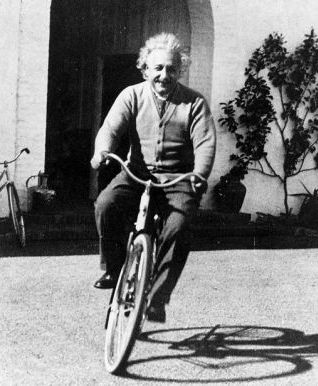
Life is Like Riding A Bike

"Life is like riding a bicycle.  To keep your balance you must keep moving."  Albert Einstein


Albert Einstein was a pretty smart fellow and not just in math and science.  When reading quotes from him, I have to conclude that he had a great grasp of what life is all about.  The quote above is certainly in line with a healthy chiropractic lifestyle.

Balance is a key to both physical and mental health.  I don't know whether Albert Einstein was referring to one or both of these areas of life when he made this statement.  Motion is crucial for health in both areas.

In physical health it's easy to see how motion is a critical element.  Motion tones our nerves and muscles and it keeps our circulatory system functioning.  As we move our body systems become coordinated so everything works together.  That is the prerequisite to having physical balance.

As a chiropractor, I am very focused on the how well my patients move.  The motion of the joints of the spine is particularly important.  Spinal joints that move either too much or too little will affect the nerves that exit the spine and go to all parts of the body.  This can lead to an imbalance in the nerves that control not only muscle activity but sensations such as pain and feelings as well as organ function.  When spinal joints loose their proper motion and the nervous system loses its balance, that is termed a vertebral subluxation.  Correcting vertebral subluxations with specific adjustments is what chiropractors specialize in.

Physical balance requires motion in more areas than just the spinal joints.  All the joints of the body must move properly and all the body's systems must be working together in a coordinated fashion.  Its the nervous system that assures the coordination of the entire body..

Being balanced mentally also requires motion.  Physical motion provides proper blood flow to the brain.  Through the blood the brain receives the oxygen, nutrients, and hormones necessary for it to work properly.  Also through physical motion the brain obtains stimulation from every part of the body.   Keeping mentally active is also necessary for to have mental balance.  Keep the mental "gears" turning through constant learning and stimulation to keep the mind healthy. 

A chiropractic lifestyle involves keeping the spine functioning properly as well as adopting healthy diet, exercise, nutrition, and sleep habit,   It's about managing physical, chemical, and emotional stresses so the body and mind can function the way they were designed to.  To be healthy we need to be balanced, physically and mentally.. Sitting in front of the TV in no way promotes balance.  Balance requires movement.  Take it from Albert Einstein, to be balanced we need to keep moving.  He was a wise man.

Tuesday, 1 January 2013

5 EASY STEPS TO BECOME UNHEALTHY IN 2013

If your New Year's Resolution is to become less healthy this year, I have 5 easy steps for you to take to reach your goal.

  1. Inactivity – Lack of physical activity will result in increased risks of circulation problems, heart disease, diabetes, digestive problems, sleep disturbances, muscle wasting, joint problems and mental health issues. It's not just physical activity you want to avoid but mental stimulation as well. Being a couch potato in front of the TV might be a great place to start.  This will minimize both your physical and mental activity levels.
  2. Poor Nutrition – Eat as much as you can of whatever looks good and tastes good. Go for high sugar, deep fried, highly salted, high calorie, processed and genetically modified foods.  Avoid natural foods, especially fresh vegetables (green = bad) and fruit.  Consuming large quantities of alcohol will also deplete your nutritional reserves.  Without essential building blocks the body is unable to repair itself and all its systems gradually breakdown.
  3. Poor Supplementation – Don't take any supplements.  Rely on the nutrient deficient foods you choose (see #2) to supply what your body needs, even though these foods don't have what the body needs.  Even more detrimental to your health is to take supplements that your body can't absorb or that are in forms that the body can't utilize. Choose low quality supplements that contain toxins and fillers. This is sure to stress the body chemically.
  4. Stress Response – Prolonged stress has been shown to be a causative factor in 8 of the 10 most costly illnesses. This includes cardiovascular disease, some cancers, gastrointestinal disorders, respiratory problems, spinal conditions, as well as mental health conditions.  So don't develop mechanisms to reduce your stress levels. Let your stresses eat away at you both mentally and physically.
  5. Nerve Interference – Don't worry about using proper body mechanics. Ignore aches, pains and stiffness in your spine.  A poorly working spine affects the nervous system, which is the master control of the entire body.   It only takes as much pressure on a spinal nerve as the weight of a dime to reduce the function of that nerve by 60%. Then every tissue that nerve goes to will be compromised. Be sure not have any chiropractic adjustments to correct vertebral subluxations and reduce nerve irritation in the spine.

I don't know which of these steps will cause the greatest deterioration in your health, but be assured that if you do all 5 of them you will definitely go downhill this year. It doesn't get any easier than that!  Going downhill is always the easy path.

But perhaps becoming unhealthy isn't really your resolution for 2013.  Do you instead want to get healthier? Then you will want to do the opposite of the things I've listed. Increase your physical and mental activity, improve your nutrition, take high quality supplements, control your stress levels, and reduce nerve interference with chiropractic care.  As chiropractors we can help you become healthier this year.

Tuesday, 13 November 2012

Forgetfulness


It's very frustrating that as a person gets older, it gets hard to remember even simple things.  Where did I put my keys? What did I come into this room for?  What did I have for lunch yesterday?  The list of what I forgot just gets longer and I'd tell you all the things that are on it, if I could just remember where I put it.  It's frustrating.

However, our memories don't have to get bad with age.  There are things that can be done to prevent, slow and even reverse age related memory loss.  Like so many problems that show up as we age, memory issues are best dealt with when we are young and before there are any signs of forgetfulness.

Memory is dependent on the proper functioning of a series of complex chemical reactions in the brain.  These reactions occur within the nerve cells and between the nerve cells.  First these reactions need to take place in order for the memory to be encoded.  Then there needs to be another series of reactions to retrieve the memory.  Any disruption in either process and we cannot remember what we wanted to.  As we age there is a tendency for the brain to produce memory related neurotransmitters which allow one nerve cell to communicate with other nerve cells.  There can also be a decline in the chemical make up of the cells themselves resulting in less efficient processing of information.  Memory is an indicator of not only how well the brain is working, but the entire nervous system.  Nervous system health is the primary focus of chiropractors.

In his book, "Brighter Mind", Kyl Smith D.C. has a four step program to prevent mental decline or to improve mental performance in those already experiencing problems.  Dr. Smith uses many scientific studies to illustrate his approach to boosting brain function.  He references over 1500 peer reviewed scientific studies.  The bottom line is that there are simple action steps that anyone can take to improve their mental capacities, including memory.  I like Dr. Smith's approach because it fits in with a healthy chiropractic lifestyle that I think is beneficial for everyone.

The four steps are to nourish, support, improve, and protect your mind.
  1. Nourish -This means to feed, maintain and support.  To function properly it is absolutely essential that the brain has adequate amounts of all the B-Vitamins, Vit. E, Vit. C, Vit. D, beta carotene, potassium, magnesium, zinc, iron, essential fatty acids, and CoQ10.  The best way to get these nutrients is from a diet consisting of unprocessed foods with an emphasis on vegetables, fruits, seeds, and nuts.  Wild fish, free range poultry, and grass fed animals are also recommended.  While it is necessary to consume foods which contain the necessary nutrients, it is equally important to avoid foods which deplete those nutrients.  In the simplest term, this means no processed foods.  Processing destroys essential nutrients while adding many chemicals which interfere with brain function.  Dr. Smith says, "A diet high in processed foods can literally starve your brain."  Inadequate brain nutrition results in poor concentration, mental fatigue, depression, learning disabilities, disturbed sleep, and loss of memory.
  2. Support - This means to assist, help and maintain.  Closely related to nourishing, supporting the brain means selecting slow release carbohydrates over sugars or carbs that are quickly converted to sugar.  Most refined grains fit into the latter category.   Consume  good quality amino-acid rich protein. Such proteins are best found in whey, dairy, eggs, fish, and beef, Yes, red meat is good to support brain function.  Omega 3 fatty acids are essential to support the brain.  These can be either plant derived or marine derived.  Those from marine sources are better because they are already in the form your brain utilizes.  A healthy cardiovascular system also supports the brain.
  3. Improve - This means to enhance or make better.  There are naturally occuring substances that will actually improve the function of the brain and they have no side effects.  These include phoshadylserene (PS), GPC (L-alpha-glycero-phosphorylcholine; yikes! Just call it GPC.)  ALCAR (acetyl-L-carnitine), and DMAE (dimethyl-aminoethanol),   Of these supplementing PS and ALCAR show the most brain improvements.  Exercise, both mental and physical, is very beneficial for improving the mind.  Good sleep is also essential.
  4. Protect - Means to guard, shield and defend.  The brain is particularly susceptible to damage from toxins and oxidation.  Oxidation is a product of metabolism in the body and is amplified by stress of all kinds.  Nutrients which protect the brain include: CoQ10, Vit. C, Vit. E, R-Lipoic Acid, ALCAR, resveratrol, grape seed extract, anti-oxidant rich berries and beans, vinpocetine, ginko biloba, rhodiola, and green tea,   This is a long list and not every person needs to consume all of these.  It is best to get most of them from a diet consisting of natural foods and then supplement with those that will specifically address an individual's situation.
The bottom line here is to improve one's diet by eating less processed foods and more vegetables and fruits, supplement to get hard to obtain nutrients and omega 3 fats, and exercise both the mind and the body.  Do this and your mind will work better.  You won't be as forgetful.